
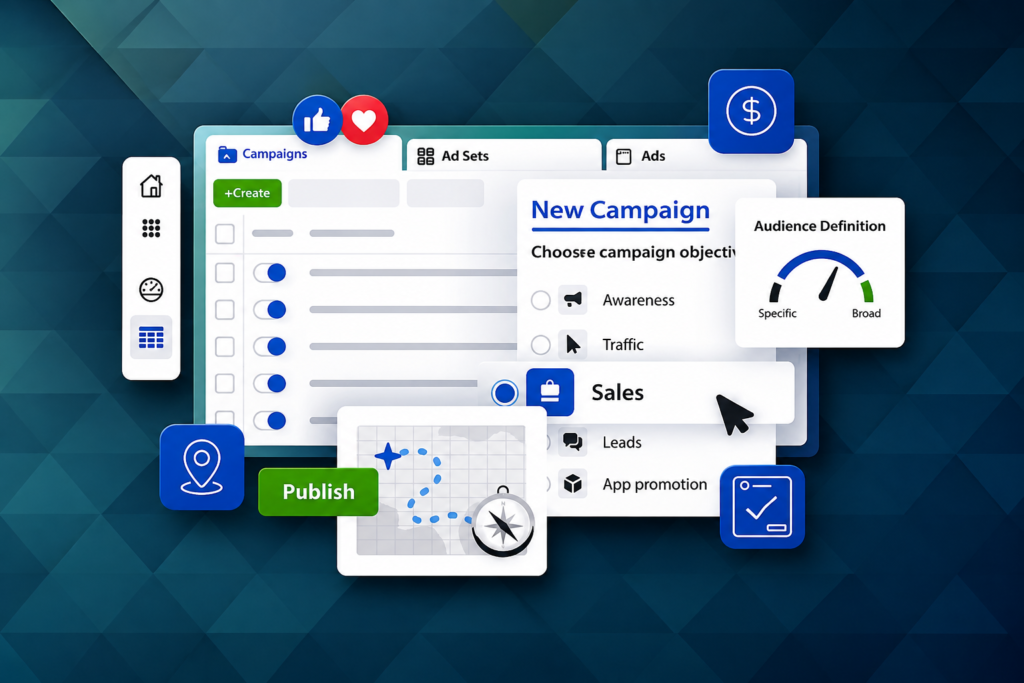
Meta Ads have become an important advertising tool for businesses that want to reach potential customers on platforms such as Facebook and Instagram. Whether you are a small business owner, service provider, online seller, or growing brand, paid social media advertising can help you reach a specific audience and promote your products or services more effectively.
However, simply creating an advertisement and setting a budget does not guarantee good results. Successful advertising requires a clear objective, the right audience, attractive creatives, persuasive copy, and continuous optimization.
A well-planned Meta Ads campaign can help businesses increase brand awareness, generate leads, drive website traffic, promote products, and improve conversions. The key is to understand how the platform works and use your budget strategically.
What Are Meta Ads?
Meta Ads are paid advertisements that businesses can create to promote their products, services, content, or brand across Meta’s advertising platforms. These ads can appear in Facebook and Instagram feeds, Stories, Reels, and other available placements.
Businesses can choose different campaign objectives depending on what they want to achieve. Some businesses may focus on generating leads, while others may want website visitors, sales, messages, or greater brand awareness.
The biggest advantage of Meta advertising is the ability to reach specific groups of people based on available audience signals such as location, demographics, interests, behavior, and previous interactions.
Why Are Meta Ads Important for Businesses?
Organic social media content can help businesses build a relationship with their audience, but reaching new people organically can take time. Paid advertising can help businesses reach a larger and more targeted audience.
For example, a local business can create an advertisement specifically for people in a particular area. An online store can promote a product to people who are likely to be interested in that category.
Meta Ads can also be useful for testing different marketing messages. Businesses can compare different creatives, audiences, and offers to understand what attracts the best response.
This makes paid advertising more than just a way to get visibility. It can also become a source of useful marketing data.
Define Your Advertising Goal
Before spending money, decide what you want your campaign to achieve.
Your goal could be:
- Generate leads
- Increase sales
- Get more website visitors
- Receive more messages
- Promote a product
- Increase brand awareness
- Increase engagement
- Promote a special offer
Having one clear objective makes it easier to create the right advertisement and measure its performance.
For example, if your main goal is lead generation, your advertisement should encourage interested users to provide their information or contact your business.
If your goal is sales, your campaign should focus on product benefits, trust, pricing, offers, and a clear path to purchase.
Understand Your Target Audience
One of the most important parts of successful Meta Ads is understanding your audience.
Before creating an advertisement, ask yourself:
- Who is my ideal customer?
- What problem do they have?
- What solution am I offering?
- Where are they located?
- What interests them?
- What type of content do they engage with?
- What might stop them from purchasing?
For example, a digital marketing service may target small business owners who want to increase their online visibility and generate more leads.
When you understand your audience, you can create advertisements that speak directly to their needs instead of showing generic messages.
Create Attention-Grabbing Visuals
Social media users scroll through large amounts of content every day. Your advertisement needs to capture attention quickly.
Good ad creatives can include:
- Short videos
- Reels
- Images
- Carousels
- Product demonstrations
- Before-and-after visuals
- Educational graphics
- Customer-focused content
Your visual should communicate the main idea quickly. Avoid unnecessary design elements and excessive text.
A clean and professional creative can make your message easier to understand.
For example, instead of creating an image with several paragraphs, focus on one strong message and one clear benefit.
Write Better Ad Copy
Visuals may attract attention, but your copy helps explain why people should take action.
Good ad copy should focus on the customer’s needs rather than only talking about the business.
For example, instead of saying:
“We provide digital marketing services.”
You could say:
“Want to attract more customers online? Discover practical digital marketing strategies designed to improve visibility and generate quality leads.”
A strong advertisement usually includes a clear benefit and a call to action.
Common calls to action include:
- Learn More
- Contact Us
- Send Message
- Get Quote
- Shop Now
- Sign Up
Choose a CTA that matches your campaign goal.
Choose the Right Audience
Meta provides different audience options that advertisers can use to reach potential customers.
You can create audiences based on factors such as location, demographics, interests, and other available targeting signals.
You can also use audiences based on previous interactions with your business, such as people who visited your website or interacted with your social media content.
Another useful option is creating similar audiences based on existing customer or audience data where available.
The right audience depends on your business, campaign objective, and available data.
Set a Realistic Budget
You do not always need a huge budget to start advertising.
If you are new to Meta Ads, start with a budget that your business can comfortably afford for testing.
The initial goal should be to learn which audience, creative, and message performs better.
Once you have enough performance data, you can make informed decisions about increasing or adjusting your budget.
Avoid spending a large amount immediately without knowing whether your campaign is reaching the right people.
Test Different Ad Creatives
Testing is one of the most useful parts of paid advertising.
Instead of creating only one advertisement, test different versions.
You can test:
- Different images
- Different videos
- Different headlines
- Different captions
- Different CTAs
- Different offers
- Different audience groups
For example, one advertisement could focus on a discount while another focuses on the benefits of the product.
After collecting enough data, compare the results and identify which version performs better.
Testing allows marketers to make decisions based on actual campaign performance instead of assumptions.
Track Important Metrics
Running Meta Ads without checking performance is like driving without looking at the road.
Important metrics can include:
Reach: The number of people who saw your advertisement.
Impressions: The number of times your advertisement was displayed.
CTR: The percentage of people who clicked after seeing your advertisement.
CPC: The average cost for each click.
CPM: The cost for reaching one thousand impressions.
Cost per Lead: Useful when the campaign is designed to generate leads.
Conversions: The number of people who completed the desired action.
Do not focus only on likes or comments. A campaign with fewer likes can still be successful if it generates quality leads or sales.
Improve Your Landing Page
Getting someone to click your advertisement is only the first step.
If users click the advertisement but leave without taking action, your landing page may need improvement.
A good landing page should:
- Load quickly
- Work well on mobile
- Match the advertisement
- Clearly explain the offer
- Show the main benefits
- Build trust
- Have a clear call to action
For example, if your advertisement promotes a digital marketing service, the landing page should immediately explain what the service offers and how visitors can contact you.
The advertisement and landing page should provide a consistent experience.
Use Retargeting
Not everyone will purchase or contact your business the first time they see an advertisement.
Some people may visit your website, watch your video, interact with your Instagram page, or view a product without taking action.
Retargeting can help businesses reconnect with people who have already shown interest.
For example, someone who visited a product page but did not purchase may later see another relevant advertisement.
These audiences can be valuable because they have already interacted with your business in some way.
Avoid Common Meta Ads Mistakes
Beginners often make mistakes that can reduce campaign performance.
Some common mistakes include:
- Targeting an irrelevant audience
- Using poor-quality creatives
- Writing unclear ad copy
- Having no clear campaign objective
- Spending without tracking results
- Changing campaigns too frequently
- Ignoring mobile users
- Focusing only on likes
- Not testing different creatives
- Sending users to a weak landing page
Avoiding these mistakes can help businesses use their advertising budget more efficiently.
Optimize Your Campaign Regularly
Launching Meta Ads is not the end of the process.
You should regularly review your campaign data and identify what is working and what is not.
Ask questions such as:
- Which creative gets better results?
- Which audience generates quality leads?
- Which ad has a better CTR?
- Is the cost per result increasing?
- Are users clicking but not converting?
- Which message receives the strongest response?
Based on the data, you can adjust your creatives, audience, budget, or campaign structure.
Optimization should be based on meaningful data rather than making random changes.
Meta Ads and Organic Content
Paid advertising and organic content can work together.
Organic content helps businesses build trust and demonstrate expertise, while paid advertising can help increase reach and bring more people into the marketing funnel.
For example, a business can publish educational content on Instagram and then use Meta Ads to promote selected content to a relevant audience.
This combination can help businesses build both short-term visibility and long-term brand awareness.
The Role of AI in Meta Advertising
AI is becoming increasingly useful in digital marketing.
Marketers can use AI-powered tools to generate content ideas, create different versions of ad copy, analyze information, brainstorm creative concepts, and support repetitive marketing tasks.
However, AI should support human strategy rather than completely replace it.
A marketer still needs to understand the audience, business goals, brand identity, customer needs, and campaign performance.
Combining creativity, strategy, data, and AI-powered tools can make the advertising process more efficient.
A Simple Meta Ads Strategy for Beginners
If you are starting with Meta Ads, follow a simple process:
Step 1: Choose one clear campaign objective.
Step 2: Identify your target audience.
Step 3: Create two or three different creatives.
Step 4: Write simple and benefit-focused ad copy.
Step 5: Set a realistic testing budget.
Step 6: Launch the campaign.
Step 7: Monitor important metrics.
Step 8: Compare different creatives and audiences.
Step 9: Optimize based on performance.
Step 10: Gradually increase the budget for campaigns that deliver meaningful results.
This approach allows beginners to learn from actual campaign data.
Conclusion
Meta Ads can be a powerful advertising tool for businesses that want to reach the right audience, increase brand awareness, generate leads, drive website traffic, and improve conversions.
However, successful advertising is not simply about spending more money. It is about spending strategically.
A successful campaign starts with a clear objective and the right audience. It then combines strong creative content, persuasive copy, a realistic budget, proper tracking, testing, and continuous optimization.
Businesses should focus on understanding their customers and using campaign data to make better decisions.
When used strategically, Meta Ads can become an important part of a business’s overall digital marketing strategy and help turn an advertising budget into measurable business results.
Connect